414-276-5700 608-276-5700 800-DURRANI

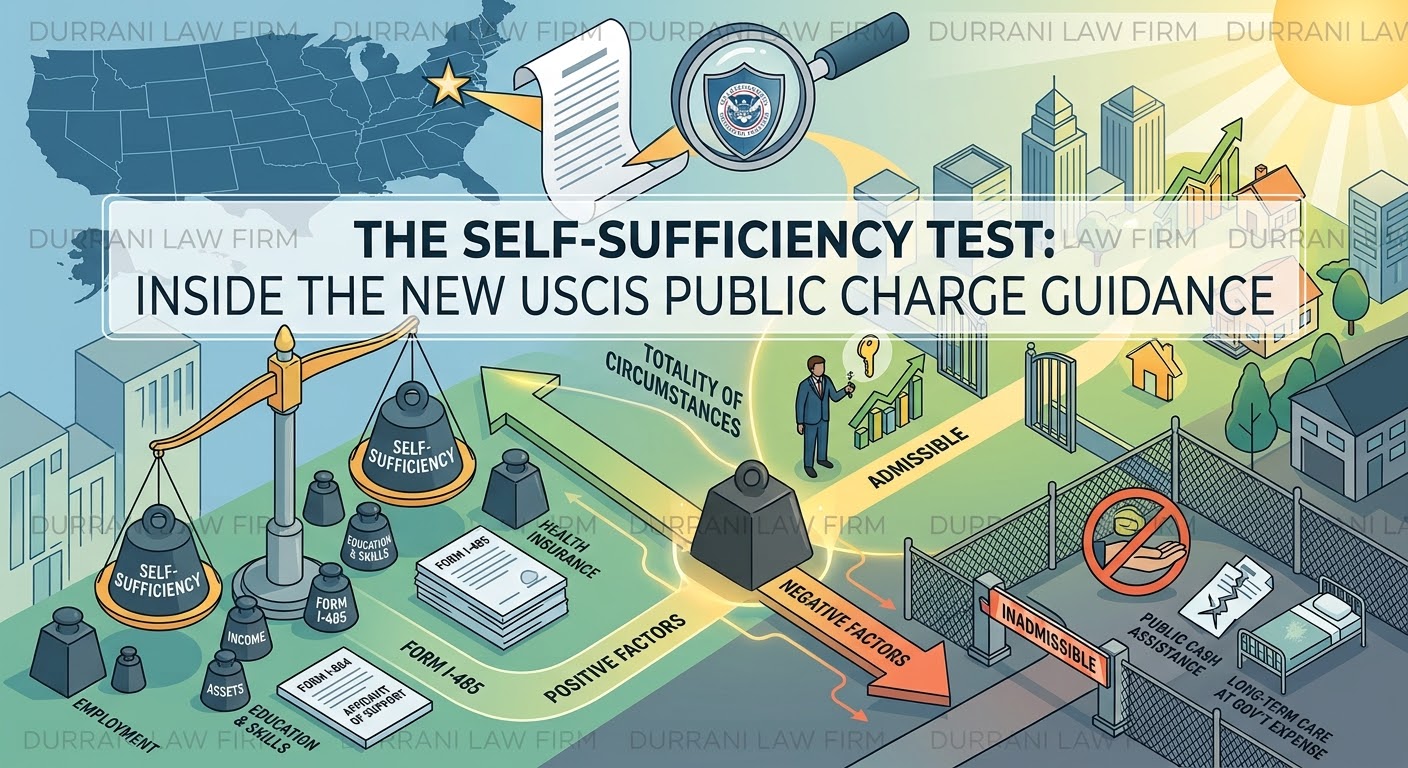
The Self-Sufficiency Test: Inside the New USCIS Public Charge Guidance

USCIS Shifts Policy: New Guidelines on Public Charge
Effective September 18, 2026, new USCIS guidance rescinds the 2022 policy, broadening officer discretion to evaluate an applicant’s potential for becoming primarily dependent on government assistance. The updated rule expands the scope of considered public benefits to include housing aid, food stamps (SNAP), and education assistance, while applying to adjustment of status applications filed on or after that date. Read the full update from the USCIS Policy Manual.
Effective September 18, 2026, this rule requires immigrants to be self-sufficient and avoid reliance on taxpayer-funded government benefits. Key aspects of the updated guidance include defining exemption rules, establishing an evaluation framework, and clarifying the public charge bond process.
Immigrants Subject to Public Charge Inadmissibility Rules:
Individuals applying for lawful permanent resident status, or a Green Card, must pass the public charge test unless their specific immigration category is legally exempt. This requirement ensures that applicants are not likely to become primarily dependent on the government for subsistence.
Deciding Public Charge Inadmissibility:
USCIS public charge evaluations are conducted on a case-by-case basis using a “totality of the circumstances” test. Although the Immigration and Nationality Act (INA) does not explicitly define what constitutes a “public charge,” it mandates that officers review five core factors:
- Age
- Health
- Family status
- Education and skills
- Assets, resources, and financial status
Officers also review Form I-864 (Affidavit of Support) to ensure a sponsor is legally committed to financially supporting the applicant.
The primary change shifts how past government assistance is evaluated:
- Before September 18, 2026: Evaluations only factor in long-term institutional care and cash assistance used for income maintenance.
- On or After September 18, 2026: The scope expands significantly to track all means-tested public benefits, including SNAP (food stamps), housing aid, and college financial assistance.
Each decision is made case by case after looking at the full picture of your circumstances.
Understanding Public Charge Bonds:
Applicants denied a Green Card solely because of public charge risks may be invited to post a public charge bond. This financial guarantee—paid via cash or a surety company—promises the government you will not use public benefits. Filing this bond correctly allows USCIS to approve your permanent residency.
Eligibility: Offered only if public charge risk is the sole ground for adjustment of status denial.
Mechanism: Requires a cash or surety bond to guarantee financial self-sufficiency.
Outcome: Proper submission allows the officer to approve lawful permanent resident status.
Setting the Amount: USCIS calculates your bond amount by estimating how much government aid you might be eligible to receive over the next five years.
Payment Methods: If invited, you can pay your public charge bond with cash or through a U.S. Treasury-certified surety company by filing Form I-945.
By Invitation Only: You can only submit Form I-945 if USCIS officially requests it in a Notice of Intent to Deny. Do not send a bond without this invitation.